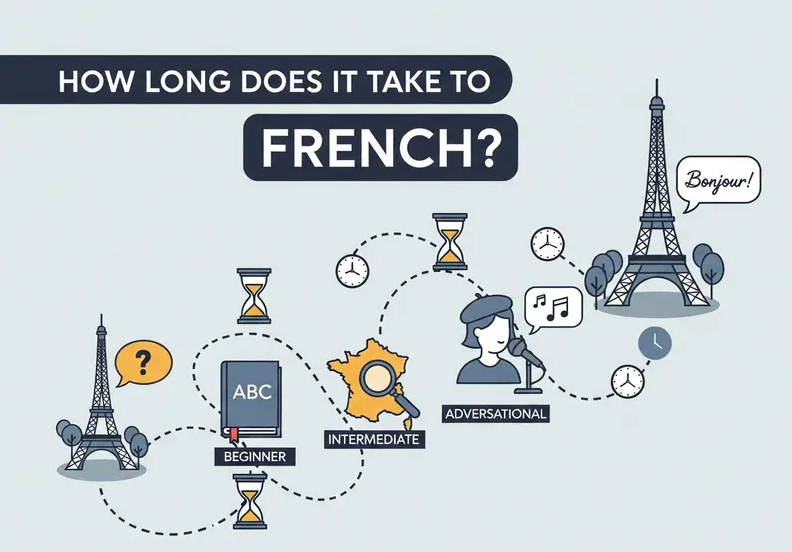
It's THE question every French student asks at some point: how long does it actually take to speak French fluently?
The honest answer is: it depends. But organizations like the FSI (Foreign Service Institute), which has trained American diplomats for decades, have established solid estimates based on thousands of students.
In this article, you'll discover how many hours are really needed, the factors that speed up (or slow down) your progress, and a realistic plan to reach your goals.
1. How Many Hours Does It Really Take?
According to the FSI, French belongs to Category 1, the group of languages that are easiest for English speakers to learn (along with Spanish, Italian, and Portuguese).
Here are the main benchmarks:
- 480 hours for a basic level (A1-A2): understanding and expressing everyday needs
- 600 to 750 hours for an advanced level (B2-C1): what most people mean by "fluent"
- 24 to 30 weeks of intensive study to reach that advanced level
Keep in mind: these numbers refer to structured classroom hours. In practice, you often need to multiply by 2 or 3 once you factor in homework, review, and independent practice.
2. What Does "Fluent" Actually Mean?
This is often where confusion starts: not everyone defines "fluent" the same way.
- B1 level: you can hold a simple conversation, travel, and handle daily life
- B2 level: you understand most exchanges, even on abstract topics, and express yourself with ease
- C1 level: you're comfortable in professional or academic settings, close to a native speaker
For most people, "fluent" corresponds to a B2 level: comfortable enough to live, work, or study in French without major difficulty.
3. The Factors That Change Everything
Two people taking the exact same number of classes can progress at very different speeds. Here's why:
- Prior language knowledge: speaking Spanish or Italian can cut learning time by 30 to 50%
- Consistency: 20-30 minutes of daily practice builds stronger connections than occasional long sessions
- Immersion: speaking with French speakers outside of class dramatically speeds up progress
- Method: structured guidance (private lessons, clear goals) prevents years of stagnation
There are countless examples of expats living in France for 5+ years who still don't speak French, simply because they never practiced outside their English-speaking circle.
4. A Realistic Plan Based on Your Goal
Here's a rough idea of the time needed depending on your target level, assuming a few hours of regular practice per week:
- A1-A2 level (everyday basics): a few months
- B1 level (independent conversation): around 6 months to a year
- B2 level ("fluent," functional in most situations): 1 to 2 years
- C1 level (near-native, professional fluency): 2+ years
These timelines assume consistent practice, not just occasional weekend study.
5. How to Get There Faster
A few practical tips to make the most of every hour you invest:
- Practice speaking from day one, even with basic vocabulary
- Aim for daily short sessions rather than long, infrequent ones
- Surround yourself with French: podcasts, shows, music, conversation partners
- Work with a tutor who can correct mistakes early and keep you accountable
The question isn't really "how long will it take?" but rather "how can I make the most of the time I put in?"
Speaking French fluently isn't about a magic number of hours, it's about consistency, the right method, and real practice. With regular effort and good guidance, most students reach a comfortable, fluent level within one to two years.
Want to speak French with confidence?
Book a private lesson and start making real progress today.
Book a Lesson