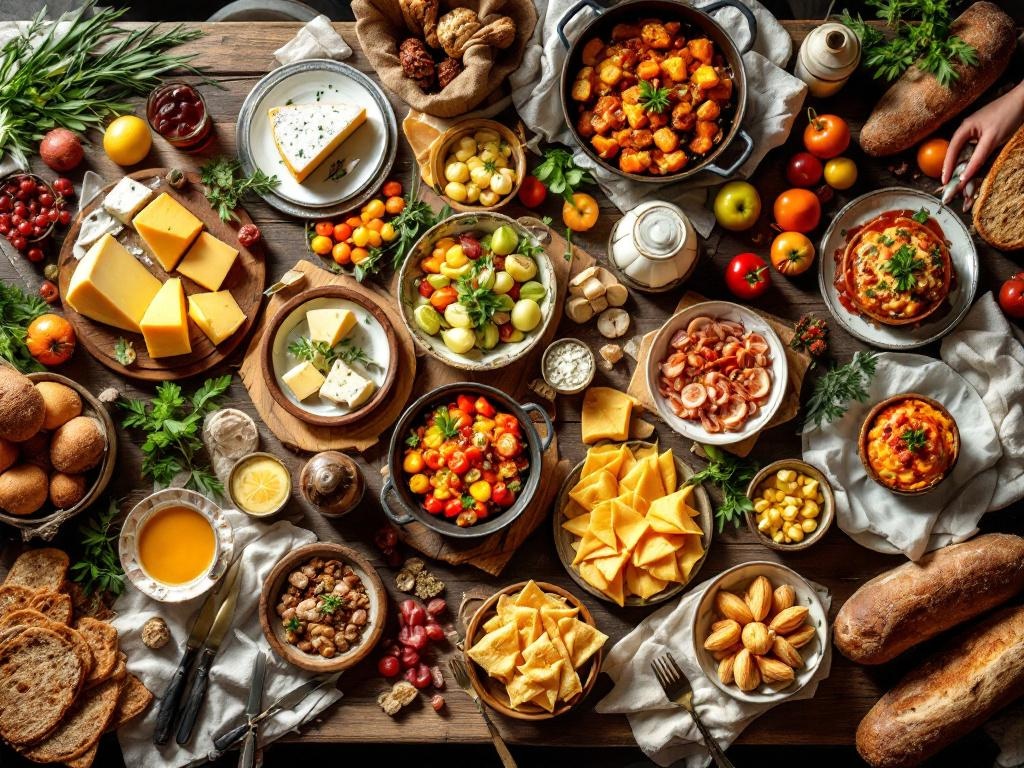
Ask a French person, "What is typical French food?" and you will probably start an argument instead of getting an answer. That's because there is no single French cuisine. There are dozens of them.
Every region, and often every city, has its own dishes, cheeses, wines, and pastries. A Breton crêpe has nothing in common with a Lyonnais quenelle, and an Alsatian Riesling tells a completely different story than a Bordeaux red. The French even have a word for this connection between a product and its home: le terroir.
In France, food is not just something you eat. It is part of local identity, and people are proud of it (and very happy to debate it). Let's take a delicious tour of France, from north to south. Along the way, you will pick up some useful French vocabulary too.
1. Normandy: Butter, Cream, and Apples
Normandy is dairy country, and it shows. Rich butter, thick crème fraîche, and some of France's most famous cheeses come from here. Apples grow everywhere, so the local drinks are made from apples, not grapes.
- To eat: Camembert de Normandie, Pont-l'Évêque, and Livarot cheeses; sole normande (fish in a cream sauce); moules à la crème (mussels in cream)
- To drink: cidre (apple cider) and Calvados, a strong apple brandy
- Something sweet: tarte normande, an apple tart with a creamy custard
Fun tradition: the trou normand ("Norman hole"). Between two courses of a big meal, people drink a small glass of Calvados to "make room" for the next course.
2. Brittany: Crêpes and Salted Butter
Brittany (la Bretagne) sits on the Atlantic coast, and the sea shapes the cuisine. Salted butter (beurre salé) is a point of pride here and goes into everything, including desserts.
- To eat: galettes, savory crêpes made with buckwheat flour (the classic galette complète has ham, cheese, and an egg); oysters from Cancale
- To drink: cidre, traditionally served in a small ceramic bowl called a bolée
- Something sweet: sweet crêpes; far breton (a custard flan with prunes); and the kouign-amann, which means "butter cake" in Breton, a flaky, caramelized, incredibly buttery pastry from Douarnenez
All across France, people eat crêpes on la Chandeleur (February 2). Tradition says you should hold a coin in your hand while flipping the crêpe to have a prosperous year.
3. Paris: The Capital of Bread and Pastries
Paris is where the food of the whole country ends up, but it also has its own icons, especially at the boulangerie (bakery) and the pâtisserie (pastry shop).
- To eat: the jambon-beurre (a baguette sandwich with ham and butter, France's favorite sandwich); soupe à l'oignon (French onion soup)
- To bake and share: baguettes, croissants, éclairs, macarons, and the Paris-Brest, a ring of choux pastry filled with praline cream, created in 1910 in the shape of a bicycle wheel to celebrate the Paris-Brest cycling race
Fun fact: the croissant is not originally French! Its ancestor, the kipferl, comes from Austria. French bakers turned it into the flaky, buttery pastry we know today. And in 2022, UNESCO added the artisanal know-how of the baguette to its list of Intangible Cultural Heritage.
4. Alsace: A Blend of France and Germany
Alsace, in the northeast, shares a border with Germany and has belonged to both countries over the centuries. You can taste it on the plate: hearty, comforting dishes with sausages, cabbage, and beer.
- To eat: choucroute garnie (sauerkraut served with sausages and pork); tarte flambée, or flammekueche (a thin, crispy dough topped with crème fraîche, onions, and bacon)
- To drink: white wines like Riesling, Gewurztraminer, and Pinot Gris, and of course local beer
- Something sweet: kougelhopf (a yeasted cake with raisins and almonds baked in a fluted mold) and bredele, small cookies made for Christmas
Fun fact: most French wines are named after a place (Bordeaux, Chablis, Sancerre), but Alsatian wines are usually named after the grape, like Riesling.
5. Burgundy: Slow-Cooked Beef and World-Famous Wine
Burgundy (la Bourgogne) is one of the most famous wine regions in the world, and its cooking is built around its wine.
- To eat: bœuf bourguignon (beef slowly cooked in red wine); escargots de Bourgogne (snails in garlic and parsley butter); gougères (warm cheese puffs); Dijon mustard; Époisses, a strong-smelling cheese
- To drink: Pinot Noir (red) and Chardonnay (white, like Chablis). Try a kir, white wine with a splash of crème de cassis (blackcurrant liqueur)
- Something sweet: pain d'épices, a spiced honey bread from Dijon
Fun fact: the climats of Burgundy, tiny vineyard plots that each have their own name and character, are a UNESCO World Heritage Site. In Burgundy, the name of a small piece of land really matters.
6. Lyon: The Gastronomic Capital
Lyon is often called the gastronomic capital of France. The city is famous for its bouchons: small, cozy restaurants serving traditional, generous local cooking.
- To eat: quenelles (light fish dumplings in a creamy sauce); salade lyonnaise (curly lettuce, bacon, croutons, and a poached egg); cervelle de canut (a fresh cheese spread with herbs, garlic, and shallots)
- To drink: Beaujolais, a light red wine from just north of the city, and Côtes du Rhône
- Something sweet: tarte aux pralines roses, a tart covered in bright pink sugar-coated almonds
Don't panic: cervelle de canut literally means "silk worker's brain," but there is no brain in it. The canuts were Lyon's silk workers, and this is just cheese!
7. Provence: Sunshine on a Plate
Provence and the Mediterranean coast bring olive oil, tomatoes, garlic, herbs, and fresh fish. The cooking is lighter, more colorful, and perfect for long lunches outside.
- To eat: bouillabaisse (the famous fish stew from Marseille); ratatouille (a vegetable stew); salade niçoise and socca (a chickpea pancake) from Nice; tapenade (olive spread)
- To drink: rosé from Provence, and pastis, an anise-flavored aperitif you dilute with cold water
- Something sweet: calissons d'Aix (almond-shaped candies made of candied melon and almonds) and navettes de Marseille (boat-shaped biscuits with orange blossom)
Fun fact: in 1980, Marseille restaurants wrote a "charter" to define what a real bouillabaisse should contain. Yes, a rulebook for a fish soup!
8. Bordeaux: Wine Country and the Famous Canelé
Bordeaux is a synonym for wine. Vineyards surround the city, and the local food is designed to go with the wine.
- To eat: entrecôte à la bordelaise (rib steak in a red wine and shallot sauce); oysters from the Bassin d'Arcachon, traditionally served with small grilled sausages
- To drink: red wines from Médoc, Saint-Émilion, and Pomerol, mostly blends of Merlot and Cabernet Sauvignon, and Sauternes, a sweet white wine
- Something sweet: the canelé, a small pastry with a dark, caramelized crust and a soft custard center flavored with vanilla and rum
A popular story says the canelé is a child of the wine industry: winemakers used egg whites to clarify their wine, and local bakers used the leftover egg yolks in their pastries.
9. The Southwest and Béarn: Duck, Beans, and Home for Me
The Southwest has generous, rich cooking: duck, beans, and slow-cooked stews. I grew up in Pau, in Béarn, at the foot of the Pyrenees, so this region is close to my heart.
- To eat: cassoulet (a slow-cooked white bean stew with sausages and duck confit, and every town around Toulouse claims its version is the real one); garbure (a thick Béarn soup with cabbage, beans, and preserved duck); poule au pot (stewed chicken); Ossau-Iraty, a sheep's milk cheese from the Pyrenees
- To drink: Jurançon, white wines from the hills around Pau (both sweet and dry); Madiran, a powerful red; and Armagnac, a brandy from Gascony
- Something sweet: coucougnettes du Vert-Galant, almond-paste candies from Pau, named after the nickname of King Henri IV; and gâteau basque, a cake filled with cream or cherry jam
Henri IV, who was born in Pau, is famously quoted as wishing that every family could have "a chicken in the pot on Sunday" (la poule au pot le dimanche).
The great debate: in Paris, it's a pain au chocolat. In the Southwest, including Pau, Toulouse, and Bordeaux, it's a chocolatine. Which word you use tells people where you are from!
And So Much More
This tour only scratches the surface. Here are a few more regions worth a trip:
- Savoie and the Alps: fondue, raclette, and tartiflette (potatoes, bacon, and Reblochon cheese), perfect after a day in the mountains
- The Loire Valley: tarte Tatin (the upside-down caramelized apple tart) and Crottin de Chavignol goat cheese, served with a glass of Sancerre
- Champagne: sparkling wine can only be called Champagne if it comes from this region
- Corsica: mountain charcuterie, brocciu cheese, and chestnut flour specialties
French Food Vocabulary to Remember
- un terroir: the land, climate, and traditions that give a product its unique character
- une spécialité régionale: a regional specialty
- le plat du jour: today's special at a restaurant
- une boulangerie / une pâtisserie: a bakery (bread) / a pastry shop
- un fromage: a cheese
- un vin rouge / blanc / rosé: a red / white / rosé wine
- AOC / AOP: a label that guarantees a product comes from a specific place and is made in a traditional way
- Santé ! Cheers!
Example: "Qu'est-ce que vous me conseillez ?" "Je vous conseille la spécialité de la région !" (What do you recommend? I recommend the regional specialty!)
In 2010, UNESCO added "the gastronomic meal of the French" to its list of Intangible Cultural Heritage. That says a lot: for the French, sharing a meal, and knowing where the food comes from, is part of the culture, as much as the language itself.
The next time you visit France, or a French restaurant here in Austin, ask about the regional specialty. And if you enjoyed the food words in this article, don't miss our 10 funny French expressions about fruits, vegetables, and other food.
Want to talk about French food in French?
Book a private French lesson and learn how to order, ask questions, and enjoy French food like a local.
Book a Lesson